A furnace repair estimate can leave you with an uncomfortable choice. Paying for the repair gets the heat back on, but you may wonder whether that money would be better spent on a new system. Replacing the furnace costs more upfront, so you need to know what that additional expense would improve.
Repair is generally worth considering when the problem can be corrected at a reasonable cost and the furnace remains suitable for your home. Replacement becomes more attractive when the repair would be substantial, other defects are developing, or you want improvements the current equipment cannot provide.
Your current heating system affects which replacement options are practical for your Oregon City home and what they would cost to install. If you also want air conditioning, a heat pump may be worth considering because it provides both heating and cooling.
This guide explains how furnace condition, repair history, and installation costs affect the decision, including when an older furnace is worth keeping and when a different heating system deserves consideration.
At First Call Heating & Cooling, we help you compare those choices through our Oregon City heating and cooling services. We evaluate the furnace problem and explain whether a repair can restore dependable heat or replacement would better meet your home’s needs.
What Would You Be Paying to Repair?
“Furnace repair” can mean anything from correcting an ignition problem to replacing a major internal assembly. The price has more meaning once the fault and the work involved are clear.
For example, an igniter starts the burners in many gas furnaces. If it fails, the furnace may stop producing heat even though other components remain serviceable. A repair can be a sensible way to recover the heating you already had.
An overheating furnace presents a different question. Replacing a damaged component without resolving restricted airflow could leave the equipment operating under the same conditions that contributed to the trouble.
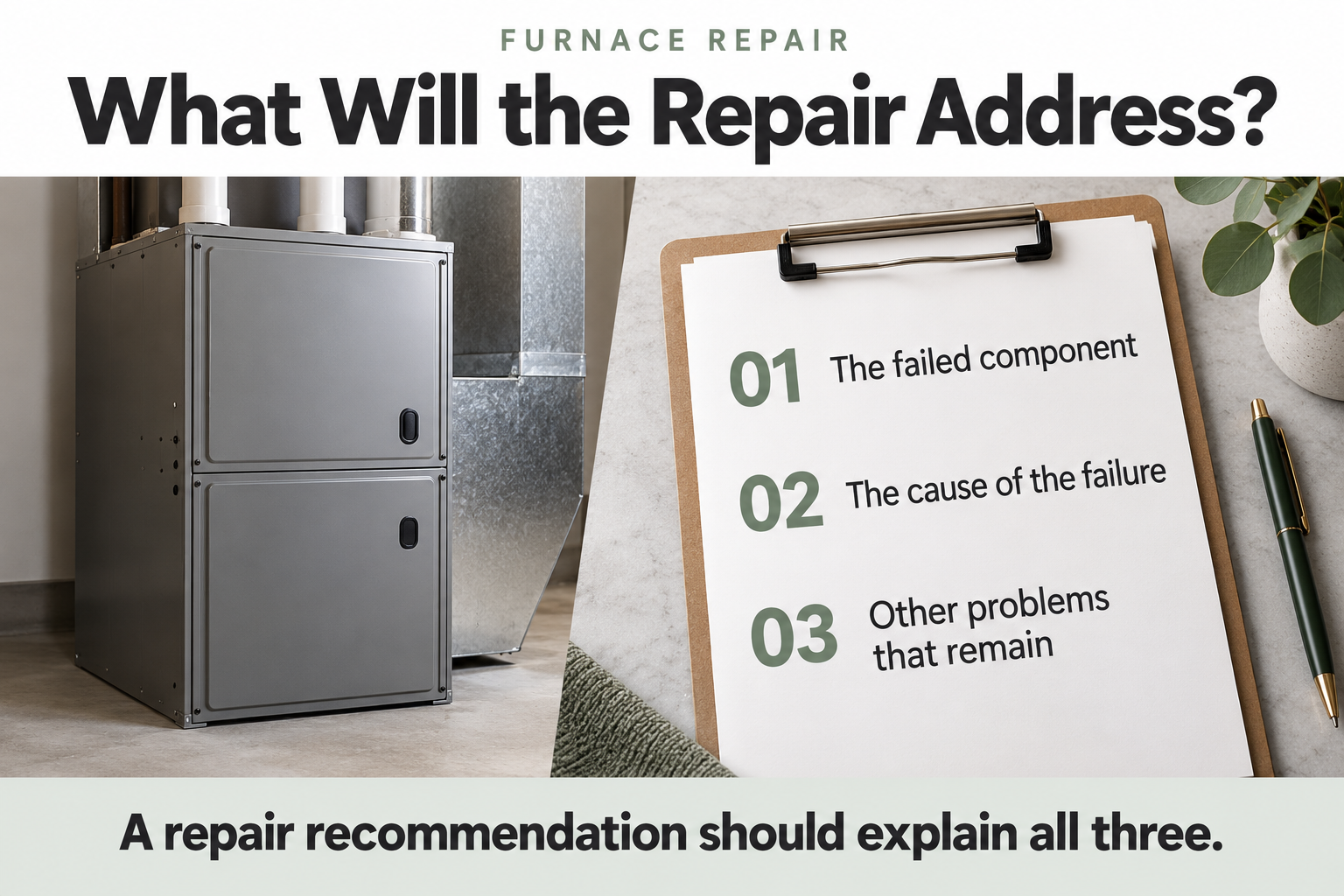
Our furnace repair service investigates the malfunction so the recommendation can address the problem identified. A noise, shutdown, or cold room helps describe what is happening, but testing is needed to establish the cause.
Major Component Work Needs a Broader Comparison
A heat exchanger separates combustion gases from the air circulating through your home while transferring heat between them. Damage to that assembly requires professional attention and can involve extensive replacement work.
Replacing a damaged heat exchanger can involve substantial labor, even when the manufacturer covers the part. Whether that work is worthwhile depends on the amount you would pay and the condition of the rest of the furnace. If other major components also need attention, replacing the furnace may offer better value. Carrier’s repair-versus-replacement guidance identifies heat-exchanger condition as one factor in that assessment.
If equipment has been taken out of service because it is unsafe, keep it off until the condition has been corrected and a qualified professional has cleared it for use.
Suspected gas leaks and carbon monoxide alarms require immediate action. If you smell natural gas, leave without operating switches or using a phone inside, then call 911 and your gas utility from a safe location. NW Natural customers can report a suspected leak at 800-882-3377. If a carbon monoxide alarm sounds, get everyone outside and call 911.
Facing a major furnace repair? Call (503) 557-0962 or schedule an evaluation with First Call. We can explain the repair and compare replacement options before you commit to the work.
The Repair History Matters More Than One Bad Day
A first breakdown after years of satisfactory heating is different from a furnace that has required several service visits since fall.
Look at what those visits involved. Routine maintenance is not the same as repeated equipment failure. Returning to resolve the same malfunction also raises a different concern from discovering unrelated defects across several components.
Past repair spending can reveal a pattern, but that money has already been spent. The next decision concerns the expense ahead: what this repair costs, what other work is already known to be needed, and how the repaired furnace is expected to perform.
| What the assessment establishes | What that means for the decision |
|---|---|
| A specific fault explains the breakdown, with no other substantial defects identified | Repair may preserve equipment that still serves the household well |
| The failure is connected to an airflow or installation problem | Corrective work needs to address that condition alongside the damaged part |
| Several components need attention, with significant spending required | A replacement proposal gives you a meaningful alternative to continued repairs |
| The equipment can be repaired, but it does not provide the comfort or capabilities you want | Compare the repair with a project designed around those additional needs |
Warranty coverage belongs in this assessment. Depending on the equipment and applicable terms, the manufacturer may supply an eligible part while other charges remain payable. Some products or agreements include labor assistance; others do not.
The useful number is your complete repair charge after coverage has been verified. A long warranty on one assembly should not be interpreted as protection against every future furnace expense.
Should You Replace a 20-Year-Old Furnace That Still Works?
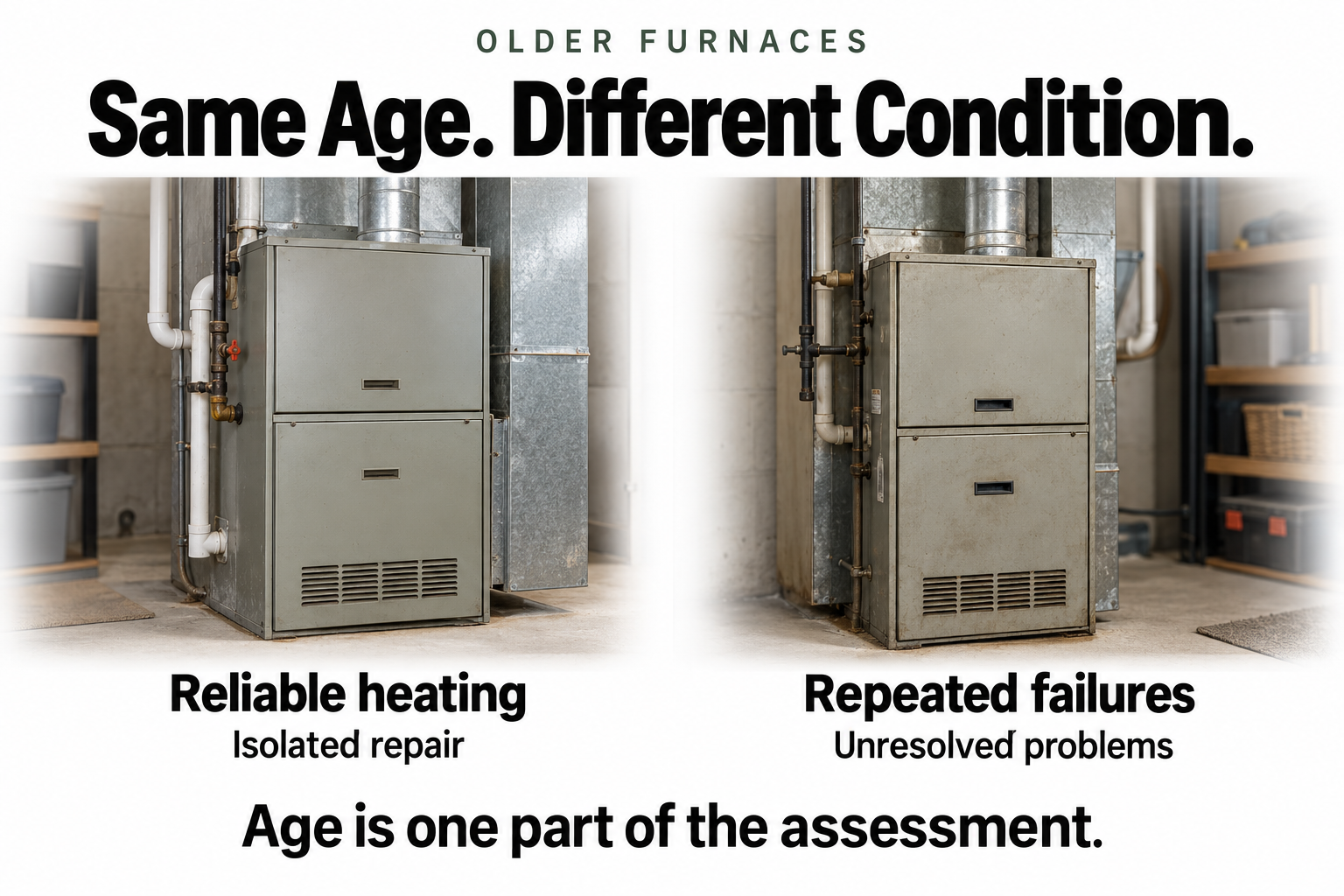
You do not automatically need to replace a furnace because it is 20 years old. A professional evaluation can establish whether it remains safe to operate, what repairs it needs, and whether those repairs justify further spending.
American Standard describes a typical gas-furnace lifespan of approximately 15–20 years, with earlier failures and longer service both possible. Equipment quality, installation, and maintenance affect that range. It is general manufacturer guidance, not an Oregon City retirement deadline.
At this age, the practical questions become more specific:
- Is there evidence of deterioration that affects safe operation?
- Have breakdowns become frequent?
- Can suitable replacement parts still be obtained?
- Does the furnace heat the home satisfactorily between service visits?
- How much additional money would the proposed repair commit to the existing equipment?
An older furnace that passes its professional evaluation and needs limited work can remain a repair candidate. An equally old furnace needing a major assembly, with other documented defects, gives you more reason to price replacement.
Planning Can Begin While the Furnace Still Heats
You do not have to wait for a complete failure to learn what replacement would involve.
An advance estimate can establish the equipment choices, installation requirements, and budget. That is useful when you are considering a fuel change or want cooling added as part of the project.
Planning also gives you a clearer basis for the next repair decision. A modest expense may be acceptable while you arrange a future installation. A substantial repair becomes harder to justify if you have already decided to replace the equipment soon.
The timing should reflect its assessed condition. An operating furnace is not necessarily safe, and a repaired furnace cannot be promised a particular number of additional winters.
Why Some Rooms Stay Cold Even When the Furnace Runs
If certain rooms were hard to heat before the furnace broke down, repairing it may restore operation while leaving those rooms uncomfortable. The inspection needs to establish whether the furnace itself is responsible for the temperature difference or whether other conditions are contributing.
A bedroom may receive too little warm air because of a restricted duct or a leak that allows heated air to escape before it reaches the room. The room may also lose heat quickly through poorly insulated walls, windows, or air leaks. Ducts running through an unheated attic or crawlspace can lose warmth along the way, making their sealing and insulation relevant to the problem.
For example, the hallway may reach the thermostat setting while a bedroom stays several degrees colder. That pattern calls for checking how much heat reaches the bedroom and how well the room retains it. Those findings help determine whether the solution involves furnace work, duct improvements, or changes to the home’s insulation and air sealing.
When replacement is appropriate, First Call’s furnace installation service considers how much heat your home needs and whether the ducts can distribute it effectively. A larger furnace alone may leave the same rooms cold, so our equipment recommendations account for airflow and the conditions contributing to uneven temperatures.
Does Your Next System Need to Do More Than Heat?
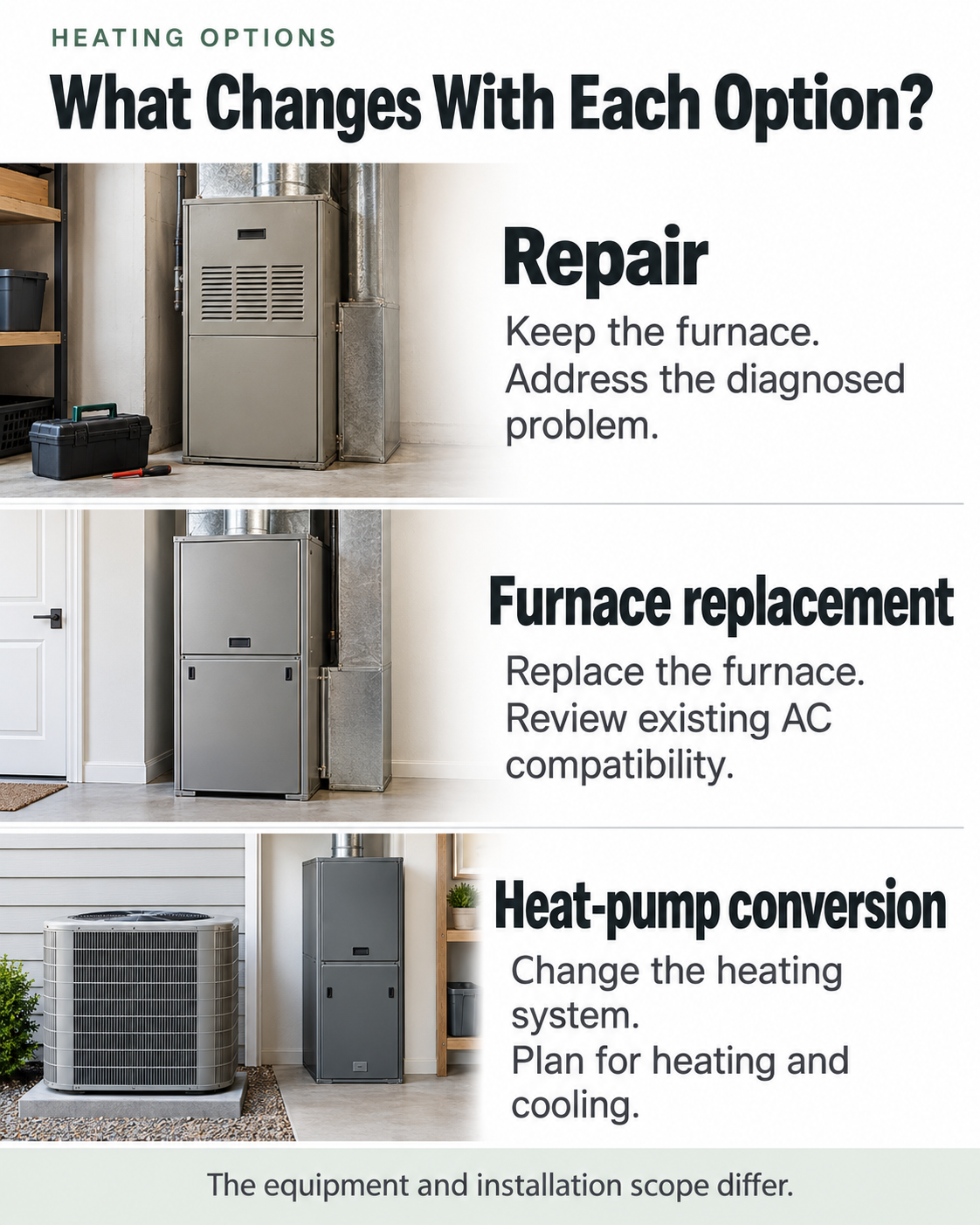
If your Oregon City home also needs better summer cooling, the replacement decision involves more than choosing another furnace. You can compare a furnace-only installation with options that address both seasons, such as adding central air conditioning or installing a heat pump. Each involves different equipment and installation costs.
A heat pump uses electricity to move heat between the outdoors and your home. It supplies heat in winter and reverses that transfer to provide cooling in summer. This gives it a different role from a furnace, which supplies heat but does not produce air conditioning.
Whether that capability is worth the conversion cost depends partly on what is installed now.
If You Currently Have a Gas Furnace
Replacing a gas furnace with another gas furnace keeps the same heating fuel, although the new model may require changes to venting, drainage, or other connections.
A heat pump introduces another choice. It can supply heating and cooling as part of an all-electric system, or it can work with a compatible gas furnace in a dual-fuel system. In a dual-fuel setup, the controls determine when the heat pump supplies heat and when the furnace takes over.
The installation price depends on which equipment stays and what must change. Any operating-cost comparison also needs to account for both gas and electricity, since a lower gas bill can be partly offset by additional electricity use.
If You Currently Have an Electric Furnace
Electric-resistance furnaces use heating elements to produce warmth. A heat pump moves heat instead, which can reduce the electricity needed to supply heating under suitable operating conditions. ENERGY STAR identifies this distinction as a reason to consider heat pumps when replacing resistance heating.
The installation still needs to be designed for the home. Cold-weather output, any supplemental heat, and electrical requirements affect both performance and cost.
Our heat-pump installation service provides an alternative to evaluate when a furnace replacement is under consideration.
If You Currently Have an Oil Furnace
Repairing the oil furnace and converting to another heating source involve different amounts of work.
First Call offers oil-to-gas or electric conversions. A conversion estimate needs to account for the new heating equipment and the connections it requires. Gas availability must be established for a gas conversion; an electric system needs suitable electrical capacity.
An underground oil tank adds an Oregon-specific consideration. Oregon DEQ states that unused underground heating-oil tanks must be emptied when oil heating is discontinued. Permanent decommissioning is a separate process that DEQ recommends; it should not be confused with simply pumping out the remaining oil.
Tank-related work therefore belongs in the conversion budget where applicable. Its scope and responsible service provider should be identified separately from the furnace installation.
What to Include When Comparing Repair and Replacement Costs
The repair total should include everything needed to correct the diagnosed problem after any confirmed warranty coverage. Separating that work from other recommended repairs makes it easier to see whether you are paying for one isolated failure or several developing problems.
Furnace replacement involves more than the price of the equipment. At First Call, the project includes assessing your home’s heating needs, selecting suitable equipment, and installing and testing the system. Installation costs also depend on the changes your home requires:
- Equipment and connections: Some installations retain compatible components, while others require changes to ducts, wiring, fuel piping, or thermostat controls. Equipment in a confined or difficult-to-reach location can take more labor to remove and replace.
- Venting and drainage: A new furnace may need a different exhaust-venting arrangement. High-efficiency condensing models also produce water, called condensate, that must drain safely. Adapting the home for these requirements can add to the installation cost, as explained in manufacturer installation guidance.
- Permits and inspections: Required approvals depend on the work and the property’s jurisdiction. Oregon’s permitting guidance distinguishes minor component repairs from more extensive heating-system changes. Within Oregon City, mechanical and electrical applications go through the city’s permit portal; properties outside city jurisdiction may follow a different process.
These details explain why replacement estimates can differ even for similar equipment. A project that requires new venting or electrical work includes more than a straightforward equipment change. First Call can also help identify energy incentives that apply to your home and selected equipment, allowing confirmed savings to be included in the comparison.
Lower Heating Bills Are One Part of the Value
Efficiency can improve the replacement case, but a rating alone is not a prediction of your next utility bill.
For fuel-burning furnaces, AFUE, or Annual Fuel Utilization Efficiency, describes seasonal heat output relative to fuel input. It does not measure every loss between the furnace and your rooms, including heat lost through ducts.
A useful operating-cost estimate should use the existing system, proposed equipment, and relevant energy rates. Household settings and weather also affect the result.
If the project introduces air conditioning to a home that previously had none, the added comfort has value. Using that cooling will also create summer electricity consumption that should be acknowledged in an annual cost comparison.
Payment Terms Affect Affordability
First Call offers financing options, subject to credit approval and lender terms. Our team can explain the available application process and payment options.
When evaluating a plan, consider the repayment schedule and total payments, including applicable interest or fees. A smaller monthly payment can result from a longer loan, so the monthly amount alone does not establish which option costs less.
Questions About Choosing Furnace Repair or Replacement
Does a Failed Blower Motor Mean I Need a New Furnace?
No. A failed blower motor can often be replaced without replacing the furnace. The decision depends on the complete repair cost, warranty coverage, and whether the remaining equipment is in suitable condition.
If airflow restrictions or an electrical fault contributed to the failure, those problems also need correction.
Can My Existing Air Conditioner Stay When the Furnace Is Replaced?
Yes, if it remains serviceable and is compatible with the new furnace. In a conventional central system, the furnace blower moves air during both heating and cooling. Its airflow and controls must work with the existing indoor AC coil and outdoor equipment.
First Call evaluates those connections and the AC’s condition when planning furnace replacement. The proposal explains which cooling components can remain and identifies any changes needed.
Would Replacing the Heat Exchanger Make the Furnace Like New?
It replaces a major assembly, but the other existing components remain. Their age and condition still affect the furnace’s future repair needs.
The benefit depends on the complete job and the equipment left in service afterward. Manufacturer coverage can make the work more affordable without renewing the entire furnace.
Should I Wait Until Spring to Replace My Furnace?
Replacement can be planned for a convenient time when the equipment remains safe and adequate for heating. Waiting is harder to justify if a professional assessment identifies a condition requiring the furnace to stay off.
Scheduling and parts availability also vary. An advance evaluation helps establish whether postponing the project is reasonable for your situation.
A Heating Decision You Can Understand
Before authorizing another repair, you should be able to explain what you are buying: the fault being corrected, the furnace’s remaining condition, and the concerns that still need attention.
A replacement recommendation deserves the same clarity. It should show why the additional expense is justified and how the proposed installation will serve your household.
First Call Heating & Cooling has worked with Portland-area homeowners since 1939, with our business based in Oregon City. We provide furnace repair and installation alongside heat-pump and fuel-conversion services, giving you several paths to consider when your heating needs attention.
Call (503) 557-0962 or contact First Call Heating & Cooling to arrange an evaluation. We’ll help you understand the furnace problem and compare the next steps for your Oregon City home.